
Batteries
Modeling Electron Exchange in Voltaic Cells
Abstract
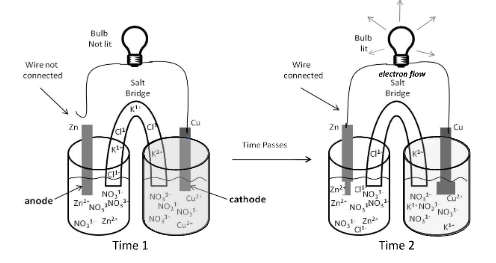
This activity, designed to support the Next Generation Science Standards (NGSS), incorporates three dimensions of learning: the Science and Engineering Practice of developing and using models to explain observed phenomena, the Crosscutting Concepts of Systems and System Models and Energy and Matter, and the Disciplinary Core Ideas related to chemical reactions and conservation of charge. Beginning with a tangible analogy of exchanging items of value, students develop a conceptual model of electron transfer that parallels oxidation-reduction processes. Subsequent models guide students to connect particle-level interactions to the macroscopic operation of a voltaic cell, emphasizing how energy transformations result from electron movement through an external circuit. Through this sequence, students construct an understanding of electrochemical systems as integrated processes that conserve charge and energy.
Level: High school
Setting: Classroom
Activity Type: Learning Cycle
Discipline: Chemistry
Course: AP Chemistry
Keywords: oxidation, reduction, redox, anode, cathode, voltaic cell, electrochemistry, electrochemical cell, electron, half-cell, reaction, salt bridge
Downloads
Published
How to Cite
Issue
Section
License
Copyright (c) 2026 Joshua Trujillo, Anoopa SinghCopyright of this work and the permissions granted to users of the PAC are defined in the PAC Activity User License.